
Residential asphalt driveways
Driveway Paving in Rapid City, SD
From the first cut to the final roll, with base depth and asphalt thickness spelled out.
- Free estimates at your property
- Line-item written quote, no door-to-door specials
- Approach and county permit questions answered up front
Building a Driveway That Survives Western South Dakota
Driveway paving covers new driveways, full replacements and gravel-to-asphalt conversions. A replacement is the right call when cracks have joined into a web, the surface has sunk or heaved, edges are falling apart, or water pools in the same places after every storm. Those are signs the base has failed, and new asphalt laid over a failed base inherits every one of those problems.
Ground conditions around Rapid City
The city spreads over ridges, valleys and the prairie east of the Hogback. Some driveways sit on shale that swells when wet; others sit on creek terraces or fill. Rapid City's council has looked at soil testing for new homes because of expansive soils. For a driveway, that means we probe the subgrade, dig out what is soft, and build back with compacted base. On sloped lots, we also plan where runoff will go so it does not run down the driveway and undercut the edges.
Section thickness
HomeGuide's guide puts a standard residential driveway at 2 to 3 inches of compacted asphalt over 6 to 8 inches of compacted gravel. If you park a camper, a horse trailer or a work truck, it recommends 3 to 4 inches over 8 to 10 inches. We size the section to the heaviest vehicle that will use the driveway and write both numbers on the quote.
Steep driveways
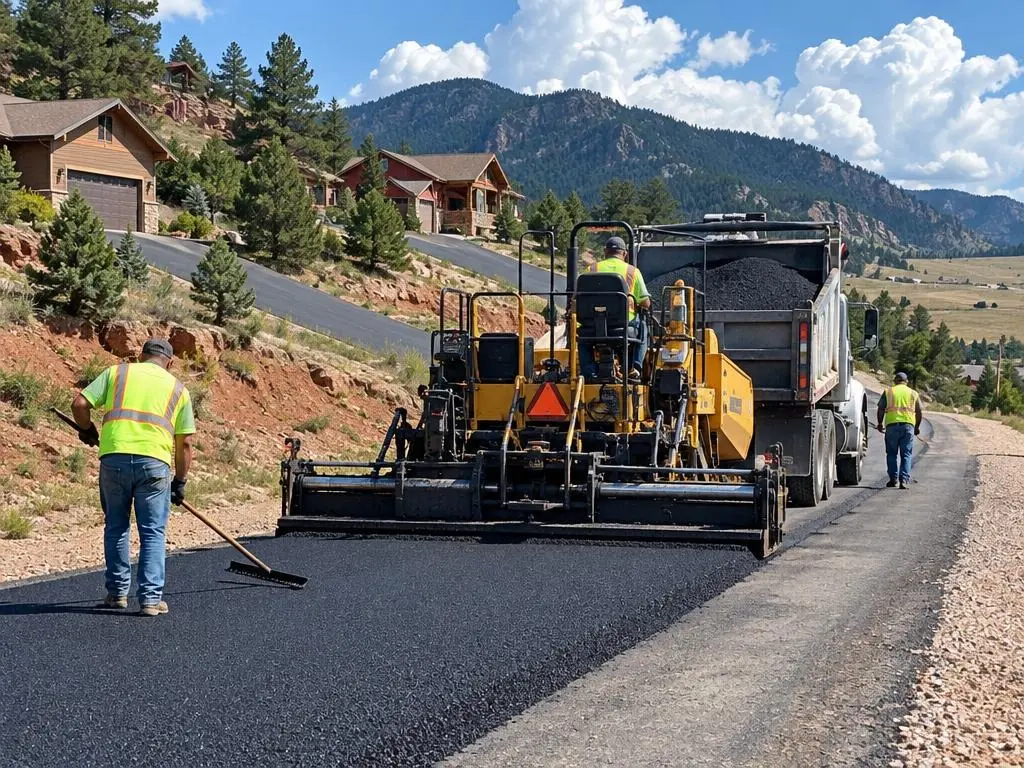
Hillside homes on the west side and out toward the Hills often have driveways that climb. Steep asphalt is harder to compact and sheds water downhill instead of sideways. We pave uphill in lifts, roll carefully, and add crown or cross-slope so water leaves the surface. At the bottom, the joint with the approach gets extra attention because that is where water and plows hit hardest.
Approach rules inside the city
Rapid City's right-of-way guide limits residential approach openings to 12 to 30 feet, not counting curb tapers, keeps approaches at least 5 feet from utilities and neighboring property lines, and requires a permit for any approach work. If your new driveway is wider than the existing approach, we tell you at the estimate whether the approach would need to change.
Gravel to asphalt
Many properties outside town start with gravel. Converting means removing ruts, adding base where the gravel is thin, compacting and paving. On long rural drives, owners sometimes pave only the stretch near the house and keep gravel or compacted millings for the rest.
After paving
New asphalt stays soft for a while, especially on hot July afternoons. Avoid sharp turns, trailer jacks and kickstands for the first few weeks. HomeGuide recommends waiting 3 to 6 months before the first sealcoat.
What a Driveway Job Includes
Every driveway gets the same sequence; only the depths change.
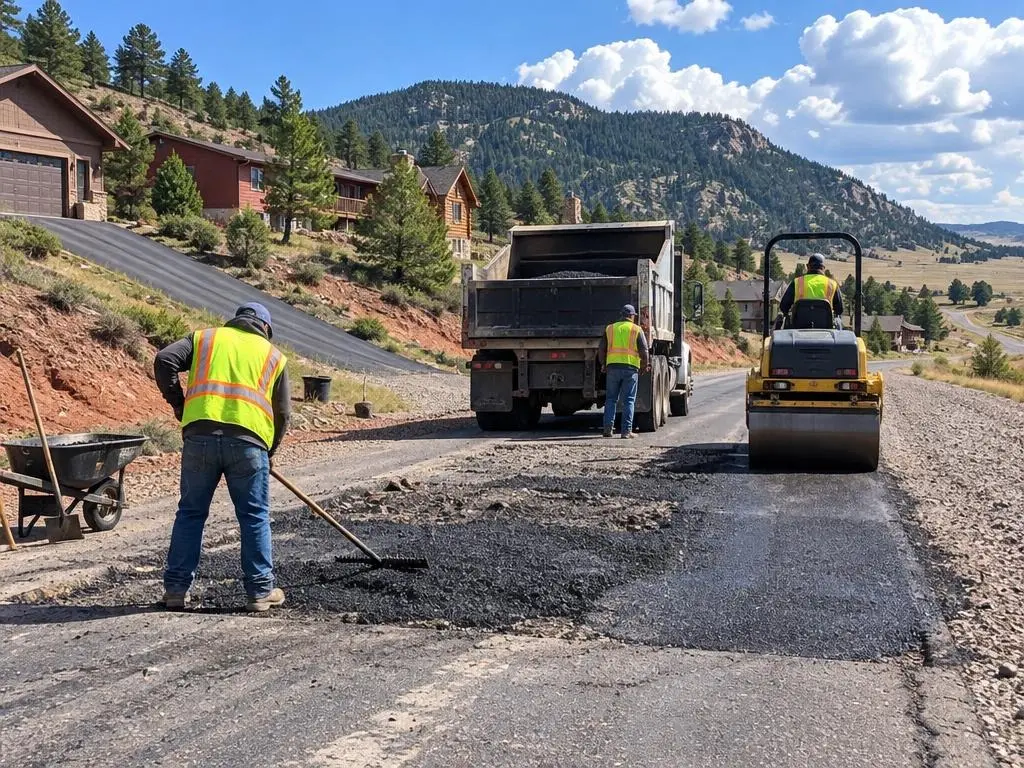
Tear-out
Old asphalt, concrete or gravel removed and hauled away.
Subgrade correction
Soft shale or clay dug out and replaced with compacted base.
Drainage shaping
Crown or cross-slope set so water leaves the pavement.
Hot-mix paving
Asphalt placed and rolled to the thickness in your quote.
Edge support
Edges tapered and backfilled so tires do not break them off.
Gravel conversions
Existing gravel drives built up, compacted and paved.
Driveway Paving Cost Ranges
| Item | Typical range |
|---|---|
| New asphalt driveway (HomeGuide) | $5 to $12+ per sq ft |
| New asphalt driveway (Angi) | $7 to $15 per sq ft |
| 400 sq ft driveway (HomeGuide) | $2,000 to $4,800 |
| 1,000 sq ft driveway (HomeGuide) | $5,000 to $12,000 |
| Remove and replace (Angi) | $8 to $15 per sq ft |
| Extreme-climate mix (HomeGuide) | adds 10% to 20% |
| Contractor minimum (HomeGuide) | $2,000 or more |
Published national ranges; the source is named in each row. Black Hills prices vary with haul distance, access and season. The number on your written estimate is what you pay.
Step by Step
1. Look
We walk the driveway, probe soft spots and check slope and the approach.
2. Quote
Tear-out, base, thickness and edges priced line by line.
3. Build the base
Soft ground replaced, base graded and compacted.
4. Pave
Hot-mix placed, rolled and finished.
5. Hand-off
Written dates for driving, parking and first seal.
Driveway Paving Questions
How long does a new driveway take?
Most residential driveways take one to three working days from tear-out to final roll, depending on size and how much base work is needed. You can usually drive on it within a few days.
Should my driveway be thicker because of the winters?
Thickness is mainly about load. What protects against winter is a dry, compacted base and good drainage. We set thickness by vehicle weight and spend the extra effort on base and water.
Can you pave a steep hillside driveway?
Yes. Steep drives need careful compaction, water control and a strong joint at the bottom. We look at grade and access during the estimate.
Do I need a city permit to replace my driveway?
Only if the work reaches the approach, curb or sidewalk in the right-of-way. Rapid City requires a permit for any approach work.
Driveway Paving Service Areas
- Asphalt Paving in Rapid City, SD
- Asphalt Paving in Box Elder, SD
- Asphalt Paving in Rapid Valley, SD
- Asphalt Paving in Colonial Pine Hills, SD
- Asphalt Paving in Black Hawk, SD
- Asphalt Paving in Summerset, SD
- Asphalt Paving in Piedmont, SD
- Asphalt Paving in Sturgis, SD
- Asphalt Paving in Spearfish, SD
- Asphalt Paving in Whitewood, SD
- Asphalt Paving in Belle Fourche, SD
- Asphalt Paving in Deadwood, SD
- Asphalt Paving in Lead, SD
- Asphalt Paving in Hill City, SD
- Asphalt Paving in Keystone, SD
- Asphalt Paving in Hermosa, SD
- Asphalt Paving in Custer, SD
- Asphalt Paving in Hot Springs, SD
- Asphalt Paving in New Underwood, SD
- Asphalt Paving in Wall, SD
Get a Driveway Paving Estimate
Free driveway estimates in Rapid City and nearby towns.